Stilski predlošci
Since Gaphor 2.0, diagrams can have a different look by means of style sheets. Style sheets use the Cascading Style Sheets (CSS) syntax. CSS is used to describe the presentation of a document written in a markup language, and is most commonly used with HTML for web pages.
On the W3C CSS home page, CSS is described as:
Cascading Style Sheets (CSS) is a simple mechanism for adding style (e.g., fonts, colors, spacing) to Web documents.
Its application goes well beyond web documents, though. Gaphor uses CSS to provide style elements to items in diagrams. CSS allows us, users of Gaphor, to change the visual appearance of our diagrams. Color and line styles can be changed to make it easier to read the diagrams.
Since we’re dealing with a diagram, and not a HTML document, some CSS features have been left out.
The style is part of the model, so everyone working on a model will have the same style. To edit the style press the tools page button at the top right corner in gaphor:

Here is a simple example of how to change the background color of a class:
class {
  background-color: beige;
}
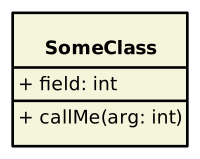
Or change the color of a component, only when it’s nested in a node:
node component {
  background-color: skyblue;
}
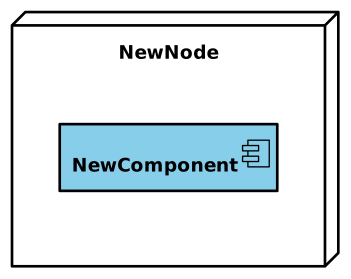
The diagram itself is also expressed as a CSS node. It’s pretty easy to define a „dark” style:
diagram {
  background-color: #343131;
}

* {
  color: white;
  text-color: white;
}
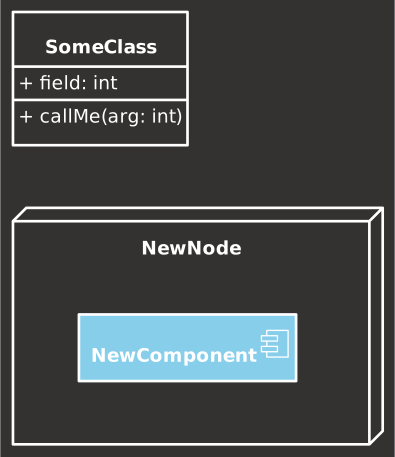
Here you already see the first custom attribute: text-color. This property
allows you to control the color of the text drawn in an item. color is used
for the lines (strokes) that make the layout of a diagram item.
Podržani selektori
Since we are dealing with diagrams and models, we do not need all the features of CSS. Below you’ll find a summary of all CSS features supported by Gaphor.
|
All items on the diagram, including the diagram itself. |
|
Any component item which is a descendant of a node. |
|
A component item which is a child of a node. |
|
Each diagram item has a class „item” assigned. This makes it easy to differentiate them from e.g. name elements. |
|
A generalization item with a subject present. |
|
A class with name „Foo”. |
|
A diagram with a name starting with „draft”. |
|
A diagram with a name ends with „draft”. |
|
A diagram with a name containing the text „draft”. |
|
A diagram with a name of „draft” or „item”. |
|
A diagram with a name is „draft” or starts with „draft-„. |
|
The focused item. Other pseudo classes are:
|
|
A node containing no child nodes in the diagram. |
|
Refers to the diagram itself. This is only applicable for the diagram |
|
A node is the first element among a group of sibling. |
|
The item contains any of the provided selectors. E.g. |
|
Match any of the provided selectors. E.g. |
|
Negate the selector. E.g. |
|
Provide extra content after a text.
Only the |
Službena specifikacija za CSS3 selektore atributa.
Gaphor omogućuje selektor atributa
|=radi cjelovitosti. U ovom kontekstu vjerojatno ipak nije od velike koristi.Gaphor CSS ne podržava ID-ove za elemente dijagrama, stoga se CSS sintaksa za ID-ove (
#some-id) ne koristi. Sintaksa za klase (.some-class) se trenutačno također ne podržava.
Svojstva stilova
Gaphor podržava podskup CSS svojstva i neka Gaphor specifična svojstva. Tumač stilske tablice je relativno jednostavan. Sve širine, visine i veličine mjere se u pikselima. Ne možeš koristiti složene deklaracije stilova poput HTML/CSS svojstva font, koje može sadržavati obitelj fontova, veličinu, debljinu.
Some properties are inherited from the parent style. The parent often is a diagram.
When you set a color`` or a font-familyondiagram`, it will propagate down
to the items contained in the diagram.
Boje
|
Primjeri:
|
|
Boja za linije. (naslijeđeno) |
|
Boja za tekst. (naslijeđeno) Zastarijelo od verzije 2.23.0: Koristi boju ako je moguće. |
|
Faktor neprozirnosti boje ( |
Boja može biti bilo koji CSS3 kod boje, kao što je opisano u CSS dokumentaciji. Gaphor podržava sve oznake boja:
rgb(),rgba(),hsl(),hsla(), heksadecimalni kod (#ffffff) i imena boja.
Tekst i fontovi
|
Ime fonta (npr. |
|
Apsolutna veličina (npr. |
|
|
|
|
|
|
|
|
|
Okomito poravnanje za tekst.
|
|
Postavi okomiti razmak za ikonske elemente (aktori, početno stanje). Primjer: |
|
Promijeni ponašanje prijeloma retka za tekst. (naslijeđeno) |
font-familymora biti samo jedno ime fonta. Navođenje popisa fontova kao u HTML-u nije moguće.font-sizemože biti broj CSS absolute-size values. Podržane su samo vrijednostix-small,small,medium,largeix-large.
Crtanje i razmaci
|
Radijus pravokutnika: |
|
Stil crtica: |
|
Poravnanje sadržaja za okvire.
|
|
|
|
Postavi širinu za linije: |
|
Postavi minimalnu visinu za element: |
|
Postavi minimalnu širinu za element: |
|
Postavi maksimalnu širinu (samo tekstualna polja): |
|
CSS odmak (gore, desno, dolje, lijevo). Primjer: |
padding(odmak) se određuje cijelim brojevima od 1 do 4. Jedinice (px, pt, em) se ne moraju koristiti. Za sve vrijednosti se koriste pikseli.dash-styleje popis brojeva (crtica, razmak, crtica, razmak, …)line-styledjeluje samo kada je definiran udijagramu. Iskrivljenost linija se može odrediti faktorom u rasponu od -2 do 2.
Pseudoelementi
Trenutačno je podržan samo pseudoelement ::after.
|
Dodatni sadržaj koji će se prikazati nakon teksta. |
Varijable
Gaphor 2.16.0 i novije verzije omogućuju korištenje CSS varijabli u tvojim stilskim predlošcima.
Ovo omogućuje definiranje često korištenih vrijednosti na općenitiji način. Razmisli o stvarima poput stila iscrtkane linije i boja.
Funkcija var() ima neka ograničenja:
Vrijednosti ne mogu imati zadanu vrijednost.
Varijable ne mogu imati varijablu kao vrijednost.
Primjer:
diagram {
  --bg-color: whitesmoke;
  background-color: var(--bg-color);
}

diagram[diagramType=sd] {
  --bg-color: rgb(200, 200, 255);
}
Svi dijagrami imaju bijelu pozadinu. Sekvencijski dijagrami dobivaju plavičastu pozadinu.
Upiti medija
Gaphor podržava tamni i svijetli Modus od verzije 2.16.0. Tamne i svijetle sheme boja koriste se isključivo za uređivanje na ekranu. Prilikom izvoza slika primjenjuje se samo zadana shema boja. Sheme boja mogu se definirati putem @media upita. Podržan je službeni upit prefers-color-scheme = dark kao i praktičniji dark-mode.
/* The background you see in exported diagrams: */
diagram {
  background-color: transparent;
}

/* Use a slightly grey background in the editor: */
@media light-mode {
  diagram {
    background-color: #e1e1e1;
  }
}

/* And anthracite a slightly grey background in the editor: */
@media dark-mode {
  diagram {
    background-color: #393D47;
  }
}
Stilovi dijagrama
Only a few properties can be defined on a diagram, namely background-color
and line-style. You define the diagram style separately from the diagram item
styles. That way it’s possible to set the background color for diagrams
specifically. The line style can be the normal straight lines, or a more
playful „sloppy” style. For the sloppy style an optional wobliness factor can
be provided to set the level of line wobbliness. 0.5 is default, 0.0 is a
straight line. The value should be between -2.0 and 2.0. Values between 0.0 and
0.5 make for a subtle effect.
CSS elemenata modela
Gaphor has many model elements. How can you find out which item should be styled?
Gaphor only styles the elements that are in the model, so you should be explicit
on their names. For example: Component inherits from Class in the UML model,
but changing a color for Class does not change it for Component.
If you hover over a button the toolbox (bottom-left section), a popup will appear
with the item’s name and a shortcut. As a general rule, you can use the component
name, glued together as the name in the stylesheet.
A Component can be addressed as component, Use Case as
usecase. The name matching is case insensitive.
CSS names are written in lower case by default.
However, since the CSS element names are derived from names used within Gaphor, there are a few exceptions.
Profil |
Grupa |
Element |
CSS element |
|---|---|---|---|
* |
* |
ime elementa |
ime elementa bez znakova razmaka Npr. |
UML |
Klase |
sve veze |
|
UML |
Komponente |
Uređaj/čvor |
|
UML |
Radnje |
Čvor odluke/sjedinjavanja |
|
UML |
Radnje |
Čvor grananja/spajanja |
|
UML |
Radnje |
Traka |
|
UML |
Interakcije |
Refleksivna poruka |
|
UML |
Stanja |
Početno pseudostanje |
|
UML |
Stanja |
Povijest pseudostanja |
|
UML |
Profili |
Metaklasa |
|
C4 model |
C4 model |
Osoba |
|
C4 model |
C4 model |
Softverski sustav |
|
C4 model |
C4 model |
Komponenta |
|
C4 model |
C4 model |
Kontejner |
|
C4 model |
C4 model |
Kontejner: Baza podataka |
|
SysML |
Blokovi |
Vrsta vrijednosti |
|
SysML |
Blokovi |
Osnovni element |
|
SysML |
Uvjeti |
Izvedeni uvjet |
|
RAAML |
FTA (analiza kvarova) |
jedan od I/ILI/… sklopova |
|
Ideje
Here are some ideas that go just beyond changing a color or a font. With the following examples we dig in to Gaphor’s model structure to reveal more information to the users.
To create your own expression you may want to use the Console ( → Tools → Console). Drop us a line on
Gitter and we would be happy to help you.
→ Tools → Console). Drop us a line on
Gitter and we would be happy to help you.
The drafts package
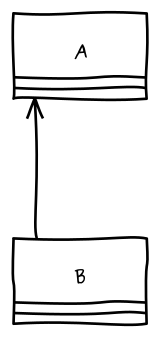
All diagrams in the package „Drafts” should be drawn using sloppy lines:
diagram[owner.name=drafts] {
  line-style: sloppy 0.3;
}

diagram[owner.name=drafts] * {
  font-family: Purisa; /* Or use some other font that's installed on your system */
}
Wrap long attributes, operations, and stereotype values
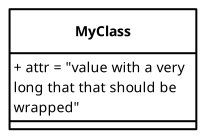
Sometimes attribute values get a bit lengthy. By default, Gaphor will not wrap text. If you want to, you can add this little snippet to wrap text for lengthy attributes on classes. You can also apply this to other types, of course.
class * {
 white-space: normal;
}
Nepovezani odnosi
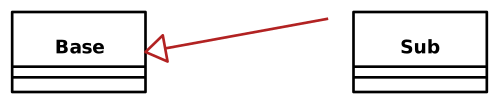
All items on a diagram that are not backed by a model element, should be drawn in a dark red color. This can be used to spot not-so-well connected relationships, such as Generalization, Implementation, and Dependency. These items will only be backed by a model element once you connect both line ends. This rule will exclude simple elements, like lines and boxes, which will never have a backing model element.
:not(:is(:root, line, box, ellipse, commentline))[subject=""] {
  color: firebrick;
}
Navigable associations
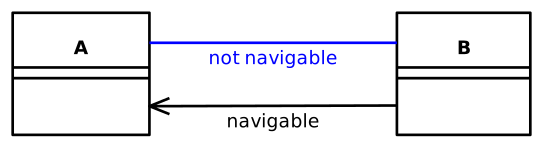
An example of how to apply a style to a navigable association is to color an association blue if neither of the ends are navigable. This color could act as a validation rule for a model where at least one end of each association should be navigable. This is actually the case for the model file used to create Gaphor’s data model.
association:not([memberEnd.navigability*=true]) {
  color: blue;
}
Solid Control Flow lines
In Gaphor, Control Flow lines follow the SysML styling: dashed. If you want, or need to strictly follow the official UML specifications, you can simply make those solid lines.
controlflow {
  dash-style: 0;
}

Todo note highlight
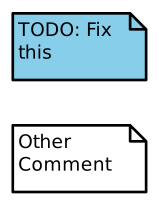
All comments beginning with the phrase „todo” can be highlighted in a different user-specific colour. This can be used to make yourself aware that you have to do some additional work to finalize the diagram.
comment[body^="TODO"] {
  background-color: skyblue;
}
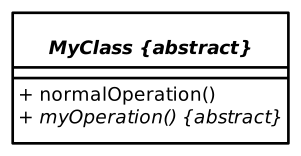
Emphesize abstract classes and operations
It may be that the italic font used is not distinguishable enough to differentiate between
concrete and abstract classes or operations.
To make this work we check if the isAbstract attribute is set on the element:
:is(name, operation)[isabstract]::after {
  content: " {abstract}"
}
Stilski predlošci sustava
/* Gaphor diagram style sheet */

* {
  --opaque-background-color: white;
  background-color: transparent;
}

:not(diagramframe):drop {
  color: #1a5fb4;
  line-width: 3;
}

:disabled {
  opacity: 0.5;
}

@media light-mode {
  * {
    --opaque-background-color: #fafafa;
  }
}

@media dark-mode {
  * {
    --opaque-background-color: #242424;
    color: white;
  }

  :drop {
    color: #62a0ea;
  }
}

:root {
  color: black;
  font-family: sans;
  font-size: 14 ;
  line-width: 2;
  padding: 0;
}

diagramframe {
  justify-content: start;
}

:is(:root, diagramframe) > pentagon {
  line-width: 1;
  background-color: var(--opaque-background-color);
}

:is(:root, diagramframe) > pentagon > diagramtype {
  font-weight: bold;
  padding: 4 0 4 4;
}

:is(:root, diagramframe) > pentagon > stereotypes {
  padding: 4 0 4 4;
}

:is(:root, diagramframe) > pentagon > name {
  padding: 4;
}

:has(.item) compartment:first-child {
  justify-content: start;
}

/* Relationships */

commentline,
c4dependency,
dependency,
interfacerealization,
include,
extend,
packageimport,
lifetime,
satisfy,
derivereqt,
trace,
verify,
refine {
 dash-style: 7 5;
}

dependency[on_folded_interface = true],
interfacerealization[on_folded_interface = true] {
  dash-style: 0;
}

/* General */

comment {
  text-align: left;
  vertical-align: top;
  padding: 4 16 4 4;
}

comment stereotypes {
  text-align: center;
}

comment body {
  padding: 0;
}

diagram > icon {
  padding: 4;
  border-radius: 4;
}

diagram > type {
  font-weight: bold;
}

metadata {
  justify-content: stretch;
  text-align: left;
}

metadata cell {
  padding: 4;
}

metadata heading {
  font-weight: bold;
  font-style: normal;
  font-size: small;
}

pentagon {
  padding: 4;
  justify-content: start;
  text-align: left;
}

/* UML */

controlflow {
  dash-style: 9 3;
}

objectnode > icon {
  padding: 4 12;
}

decisionnode > type {
  font-size: small;
}

proxyport > icon,
activityparameternode,
executionspecification {
  background-color: var(--opaque-background-color);
}

partition {
  padding: 4 12 4 12;
  justify-content: stretch;
}

package {
  padding: 24 12 4 12;
}

interaction {
  justify-content: start;
}

activity {
  padding: 4 12;
  border-radius: 20;
  justify-content: start;
}

activityparameternode {
  padding: 4 12;
  min-width: 120;
  text-align: center;
}

action,
valuespecificationaction {
  padding: 4 12;
  border-radius: 15;
}

callbehavioraction {
  padding: 4 24 4 12;
  border-radius: 15;
}

sendsignalaction {
  padding: 4 24 4 12;
}

accepteventaction {
  padding: 4 12 4 24;
}

usecase {
  padding: 4;
}

swimlane {
  min-width: 150;
  padding: 4 12 4 12;
  justify-content: start;
  white-space: normal;
}

association > end {
  font-size: x-small;
  padding: 4;
}

/* SysML */

requirement {
  justify-content: start;
}

requirement text {
  white-space: normal;
}

directedrelationshippropertypath {
  dash-style: 7 5;
}

/* Classifiers */

compartment:first-child {
  padding: 12 4;
}

compartment + compartment {
  padding: 4;
  min-height: 8;
  text-align: left;
  justify-content: start;
  white-space: nowrap;
}

artifact compartment:first-child,
component compartment:first-child {
  padding: 12 24 12 4;
}

state compartment:first-child {
  padding: 4;
}

:has(.item),
:has(compartment + compartment),
:has(regions) {
  justify-content: start;
}

regions {
  justify-content: stretch;
}

region {
  padding: 4;
  min-height: 100;
  justify-content: start;
  text-align: left;
}

region + region {
  dash-style: 7 3;
}

and name,
xor name,
intermediateevent name,
dormantevent name,
basicevent name,
houseevent name,
topevent name,
inhibit name,
conditionalevent name,
zeroevent name,
or name,
not name,
transferin name,
transferout name,
undevelopedevent name,
seq name,
majorityvote name,
unsafecontrolaction name,
operationalsituation name,
controlaction name,
interfaceblock name,
block name,
property name,
requirement name,
c4person name,
c4database name,
c4container name,
package name,
enumeration name,
interface name,
class name,
datatype name,
component name,
statemachine name,
usecase name,
actor name,
artifact name,
node name {
  font-weight: bold;
}

name[isabstract] {
  font-style: italic;
}

from {
  font-size: x-small;
}

activity > :is(name, stereotypes) {
  text-align: left;
}

compartment heading {
  padding: 0 0 4 0;
  font-size: x-small;
  font-style: italic;
  text-align: center;
}

operation[isabstract] {
  font-style: italic;
}

attribute[isstatic],
operation[isstatic] {
  text-decoration: underline;
}

property:not([aggregation="composite"]) {
  dash-style: 7 5;
}

/* Attached */

:has(icon)[connected_side] {
  text-align: right;
  vertical-align: top;
}

:has(icon)[connected_side="left"] {
  text-align: left;
}

:has(icon)[connected_side="bottom"] {
  vertical-align: bottom;
}

/* C4 model */

c4container, c4person {
  padding: 4 4 4 4;
}

c4database {
  padding: 20 4 4 4;
}

:is(c4container, c4database, c4person):has(.item) {
  justify-content: end;
}

:is(c4container, c4database, c4person):has(.item) > :is(name, technology) {
  text-align: left;
}

c4dependency name {
  max-width: 150;
}

:is(c4container, c4database, c4dependency, c4person) technology {
  font-size: x-small;
}

:is(c4container, c4database, c4person) description {
  padding: 4 4 0 4;
}